Lessons from Teaching My SAT Reading Series at schoolhouse.world
Published September 8, 2021
I had the privilege of designing and teaching my own free 8-week
SAT Reading tutoring series
over this past summer 2021 at
schoolhouse.world! In this post,
I walk through a couple of principles and techniques that significantly enhanced
my teaching, and I prove their effectiveness through all the quantitative and
qualitative student feedback I have received.
schoolhouse.world (SHW) is a free peer tutoring platform started by Sal Khan,
the founder of Khan Academy, with comprehensive tutor certification and training
policies in place to foster a safe learning environment. Anyone can tutor and
become a student! Discover more testimonials at
https://schoolhouse.world/stories.
Even though I have TA’ed before at UC Berkeley, I learned so much through this
series about teaching effectively due to one key challenge: student attendance
was completely voluntary. If anything I did were unhelpful, students could
simply decide to quit. I really needed to hone in on how I can offer a unique
learning experience beyond what other online resources provide.Ultimately, I found guided reading demos and the cultivation of simple
habits to be most impactful for my students. These activities kept students
engaged, built long-term reading skills rather than test-taking skills, and,
best of all, achieved “product–market fit” as something valuable yet unique to
my series.
Over a hundred students registered for the series initially. I knew there would
be significant attrition, so I tried to leverage the scale while I could. I
required every student to fill out an
intro survey,
which revealed some surprising insights.
Principle 1: In an online course, require effort upfront so that students feel
invested.
The most distinct aspect of my intro survey was my 200-character minimum
requirement for the question: “What do you want to get out of this series?”
Here were some example responses:
“Better SAT score for writing and get a better grade in English. This is my
weakest subject. I need more skill in English so I can get a good score. Also
English in SAT is hard so I want to improve it and get a better score.” –
Survey Response #3
“From this series, I hope to be able to answer text-based questions at a
faster pace. Usually what I do is in the following order: I read the
questions, note down different sections/paragraphs/keywords I have to look for
in the passage, and then read the passage, stopping whenever there’s a point
where a question can be answered. This process takes a lot of time and I want
to learn possible strategies that may work better for me or would speed up the
process. I think practicing paraphrasing and learning more about from guided
readings would be beneficial to develop a different approach to retaining more
information from passages.” – Survey Response #14
I showcased these responses to my students as an example of effort, taking
advantage of my class’s diversity to develop “data-driven” course content.
Some students needed to build a habit of putting effort into their introspection
and their responses.
Principle 2: Foster a growth mindset by showing examples of quality,
especially from fellow students.
In the same survey, I asked how helpful students would find a variety of
teaching techniques. The top two forms of instruction were “Guided Reading” and
“Official SAT Practice”. In “Guided Reading”, I walk through a passage,
demonstrating my strategies and periodically asking students to paraphrase what
we have read. Compare that against “Official SAT Practice”, where I let
students work on a practice test written by College Board, then go over each
question individually.Surprisingly, the survey revealed that students generally preferred “Guided
Reading” over “Official SAT Practice”, even though I thought “Official SAT
Practice” would be more relevant. At first, I paid little attention to this
insight. I did not alter my original session plan of Strategy Lecture > Strategy
Exercise > Official SAT Practice > Debrief. This approach seemed to work well
for Week 1 and 2, mainly because attendance was high, so I got by with less
student interaction.
Week 4: Diminishing Effectiveness without Guided Reading
After Week 4, I started to notice that something was wrong — I had no idea how
well students actually understood SAT passages. I only knew where students were
at when they asked me to review a particular practice passage question.My tutoring feedback reflected a similar negative trend. SHW enables students to
report each session on a three-point scale: “Super Helpful”, “Helpful”, and “Not
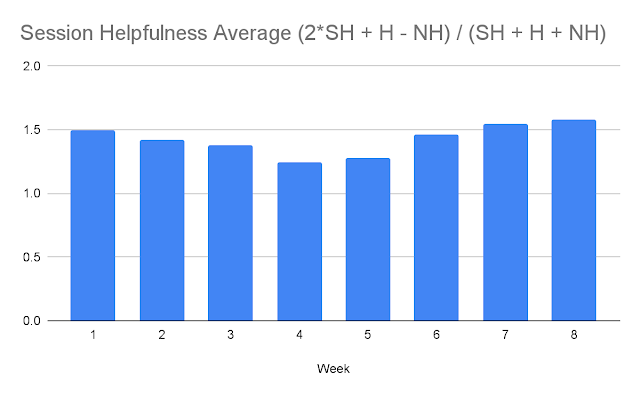
Helpful”. I define Session Helpfulness Average as (2*SH + H - NH)/(SH + H +
NH), a weighted average with SH contributing double weight and NH contributing
negative weight. My Session Helpfulness Average dropped to its lowest point in
Week 4 (11 SH, 16 H, 2 NH → (22+16-2)/(11+16+2) = 36/29 = 1.24).At this point, I knew I had to adjust something. I went back to my survey and
found that I should maybe just try out the “Guided Reading” technique I had
neglected to implement.
Principle 3: When presented with surprising data, take the time to understand
the data and adjust your behavior accordingly.
I entered Week 5 with a haphazard plan to implement Guided Reading. As defined
above, I walked through an actual SAT passage for my students, versus going
through canned strategy exercises. I would then pause at each paragraph to ask
what they observed.The result was like wearing glasses for the first time! While students
adequately summarized what we read, I saw that they would frequently miss the
nuances. I could now address that behavior in real time!But something still felt off — my demo was all over the place. I highlighted
words, drew some circles, etc. But I thought, “If I were a student, I’d have
such a hard time following the teacher.” My Week 5 metrics again reflected this
weakness (7 SH, 10 H, 1 NH → 1.28).For Week 6, I addressed this issue by focusing my demo on finding main ideas. I
made sure that I kept referencing “main ideas” as I annotated the passage. Now,
with the proper technique and execution, my metrics started to recover (6 SH, 7
H, 0 NH → 1.46).
“The way you introduce new strategies that are seamlessly included in the
lesson. I really like that we had the chance to apply those strategies as a
class.” – Week 6 Student Feedback
In hindsight, it makes perfect sense why students preferred Guided Reading in
their survey responses: Every SAT practice exam already comes with an
explanation for each individual answer choice. However, they don’t tell students
how to read a passage. Guided Reading fills that gap. Guided Reading gives me a
clear view of how well students understand what they’re reading. I can address
deficiencies on the spot. Guided Reading gives students a paradigm to emulate.
Guided Reading is the perfect bridge for showing a general strategy, how it
should be applied, and how it is effective.
“The demos were always the most helpful throughout this series and I’m glad
I’m seeing some improvement.” – Week 8 Student Feedback
Principle 4: The best teaching techniques surface immediate feedback so you
can quickly address deficits in understanding.
Of the 120 students who registered, around 50 students attended my first
session. I had enough students to produce an answer distribution for a passage,
shown below.Overall, if we took the majority answer for each question, the class scored
10/11. The questions below had the fewest correct responses:
Q3: “Which idea is presented in Passage 1 but NOT in Passage 2? (Majority was
wrong)
Q9 and Q11: “Which choice provides the best evidence for the answer to the
previous question?”
This data reinforced my class’s intuition that they had trouble with “dual
passage” and “best evidence” questions. These questions are a testament to the
SAT’s effective new format, because they really assess comprehension. Students
cannot simply look at certain lines or memorize vocabulary to get by as I did
when I took the test years ago.How in the world would I teach something as vague as “reading comprehension”?At the same time, students would constantly complain, “I ran out of time.” “I’m
having trouble finishing these passages.” Adults don’t seem to run out of time
though. What’s missing?I took inspiration from Charles Duhigg’s
The Power of Habit,
Stephen Covey’s
The 7 Habits of Highly Effective People,
and Daniel Kahneman’s
Thinking, Fast and Slow.
Aha! Students have not yet developed habits for reading efficiently. They
may be getting stuck on complex phrasing that is second nature to adults.
Principle 5: Good habits help you succeed with minimal effort.
I broke down reading into a collection of concrete skills that one can improve
on with practice. Over the course of the series, I developed this list of basic
skills:
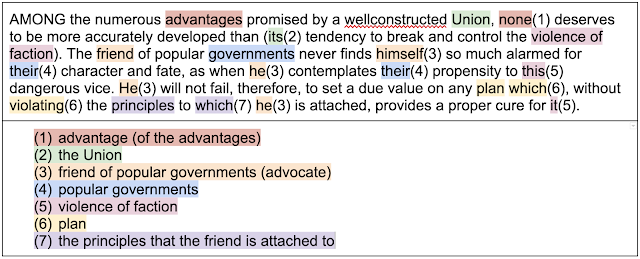
Identify subjects, verbs, and objects.
Identify the right antecedents for pronouns.
Identify transition words and words with strong connotations.
Literature: Identify elements of a narrative: characters, setting, conflict.
Take notes. Organize by drawing, etc.
Develop a checklist and stick to it.
Trust the process. (…and potentially more, yet to be discovered.)
These skills seem like second nature, but until students consciously practice
these skills, they will get lost again and again. As taught by Dr. Barbara
Oakley’s
Learning How to Learn
course, experts engage in
chunking, where
they develop significant efficiency over basic skills. For example, chess
grandmasters can picture the board many more moves ahead than amateurs can. I
believe students can achieve such mastery, even for a task as open-ended as SAT
reading, by practicing concrete skills.Now, I reference these skills as I give my Guided Reading demos. Students fully
know what to expect as I give my demos, so they are less likely to become lost.
“The tips you gave in each session (making a checklist, following pronouns,
etc.) were really helpful and helped me to better understand what I was
reading.” – End of Series Survey Response #5
The beauty of this approach is that it works for all types of reading
assignments, not just SAT Reading passages. These skills become a force
multiplier for students in their careers, not just an addition that they need to
toss away once they’re done with the SAT.
“I loved that you didn’t make it a series about “beating the test”, but rather
you taught us amazing comprehension skills that could be applied anywhere. It
was a thousand times better than the first option could have been.” – End of
Series Survey Response #6 Conclusion
Based on the above findings, I have settled on the following session format.
Introduce a simple strategy.
Demonstrate it on a sample passage. a. Solicit student feedback throughout.
Have students take a time practice passage test.
Go over the answers.
This setup generalizes well for developing any skill:
Start with a simple strategy for improvement.
Practice using it, both in isolation and on the actual task.
Test for mastery.
Repeat.
This setup is incredibly similar to the process I discovered when
learning how to type from z to a.
Working through the tedium of the process is most difficult, but hey, that’s
what a community like schoolhouse.world (SHW) is for. Everyone is passionate
about learning and teaching. My series is one of many at SHW, where there are so
many other classmates to meet, classes to take, classes you yourself can teach,
and volunteering leadership opportunities.Special thanks to the SHW team; Zoom, where SHW hosts these online sessions; and
Wacom, which gifted a
One by Wacom
tablet to every active SHW tutor.Thanks to
Maxwell Ruckstuhl,
Albert Wu, Sumukh Sridhara, and
Sarah Kim for reviewing this post! All remaining errors
are my own.


 I had the privilege of designing and teaching my own free 8-week
SAT Reading tutoring series
over this past summer 2021 at
schoolhouse.world! In this post,
I walk through a couple of principles and techniques that significantly enhanced
my teaching, and I prove their effectiveness through all the quantitative and
qualitative student feedback I have received.
I had the privilege of designing and teaching my own free 8-week
SAT Reading tutoring series
over this past summer 2021 at
schoolhouse.world! In this post,
I walk through a couple of principles and techniques that significantly enhanced
my teaching, and I prove their effectiveness through all the quantitative and
qualitative student feedback I have received.

 Overall, if we took the majority answer for each question, the class scored
10/11. The questions below had the fewest correct responses:
Overall, if we took the majority answer for each question, the class scored
10/11. The questions below had the fewest correct responses: