I took a hiatus from refereeing high school basketball 🏀 when I started my job at Anthropic, right after Claude 3 was released. Focusing full-time on AI was quite a ride, but now I’m ready to get back on the court. This time, I have an AI to study with. My time away gave me space to sit with something the NFHS basketball rulebook says in its introduction:
It is important to know the intent and purpose of a rule so that it may be intelligently applied in each play situation.But rulebooks have to be succinct. Officials, coaches, and players all need to carry the same understanding onto the court, and none of them have room for legislative history. To truly understand the “intent and purpose” of a rule, you have to reconstruct the years of debate and experience the rules committee distilled into a single sentence.
Using AI to Reconstruct Intent
That kind of reconstruction is where I’ve found AI genuinely useful. I use Claude, which is capable of graduate-level reasoning, searching the web, and citing what it finds. It compresses hours of cross-referencing into a few minutes of conversation. For example, Rule 5-11-7 states:Successive time-outs, as in Rule 4-43-2, shall not be granted after the expiration of playing time for the fourth quarter or any extra period. In all other instances, they shall be administered in the order in which they were requested.In previous years, I wouldn’t have given the clause much thought. “Ok, I see this exception but I doubt that it’ll ever come up.” This time, I asked Claude to speculate why the exception would be there. Claude came back with an insightful answer: Without this rule, teams could take advantage of their remaining timeouts to “ice” a free-throw shooter, a concept that belongs more on a football field than on a basketball court. Fascinating. You can see my conversation at: https://claude.ai/share/e67c6a89-52b8-4627-9f4b-96de7b99ed54
Setting Up a Rules Study Project
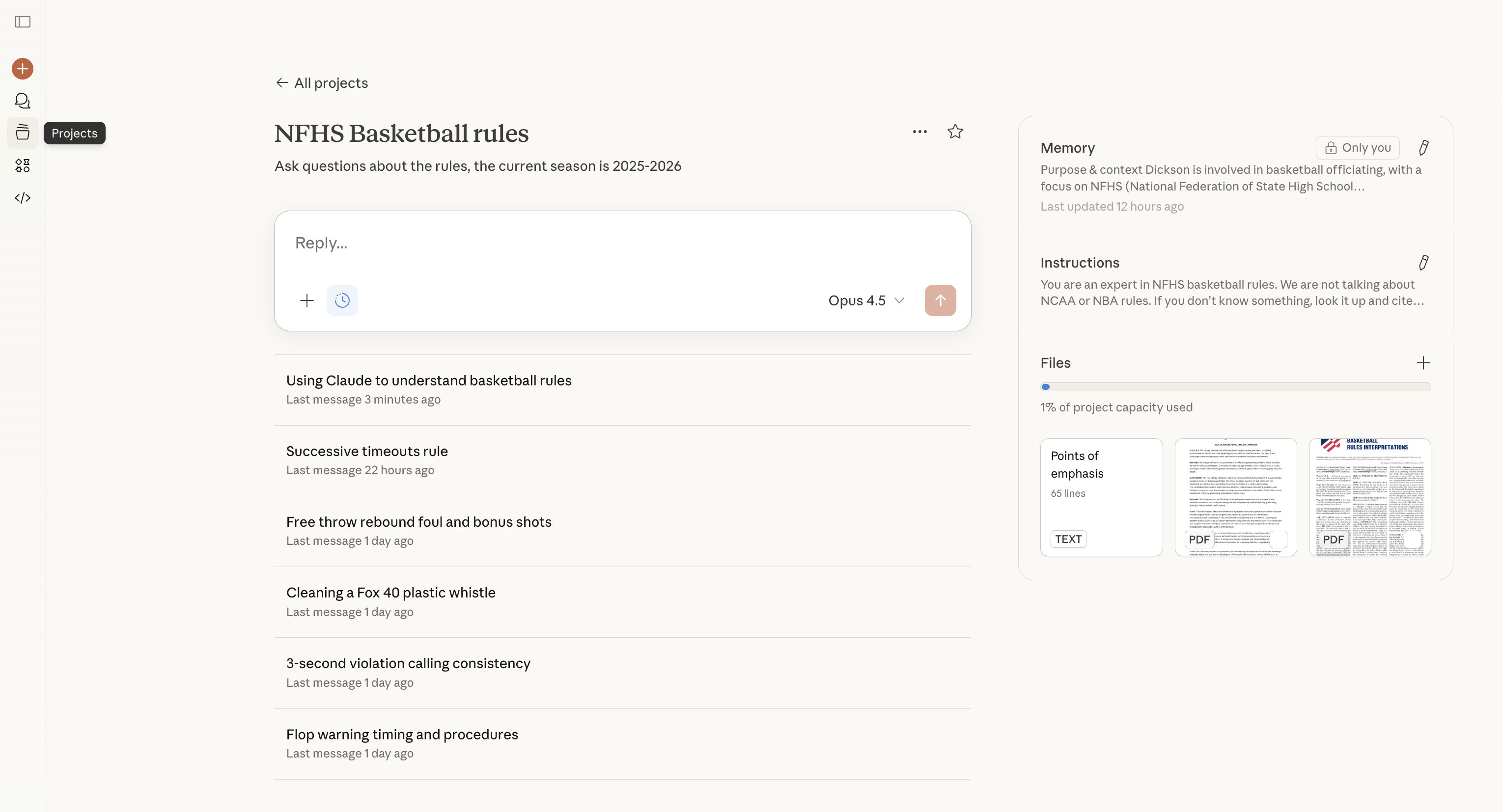
Setting up a conversation like this is pretty straightforward. I have a Claude Project that contains the latest publicly-available NFHS basketball material: the 2025-26 Basketball Points of Emphasis, Rule Changes, and Rules Interpretations.